Building Infrastructure System for Startup
Dedicated Author of LUKMANLAB
Introduction
Digitalization is currently starting to develop quite rapidly, technology helps humans create the systems they want. Initiatives can come from those who have ideas and capital or from the software creators themselves (software developers).
There are several kinds of real examples of how startups are formed, such as:
- A group of people who have been good friends for a long time and have begun to trust each other. They have complaints or have problems, then these complaints and problems become ideas that underlie the formation of software and startups.
- There is also an example of someone who has privileges from a certain authority body, he sees a lack of applications on the market today. Then this person takes advantage of this privilege to create software that indirectly complements this deficiency. The software is then offered and purchased by applications that need it. Finally, this software is used by many people. For example, suppose there is a BUMN application that has not been enhanced with the e-Wallet feature. This deficiency was exploited by people who had this privilege, then that person created a startup with an e-Wallet application that was supported by clear permissions and authorized by an authority body. Then this e-Wallet was offered and purchased by the BUMN. Furthermore, this application is used by the wider community.
- Example of how to apply Flip founded can read the story here.
As an observer, I try to understand that they are starting to think about how they can earn side income through the ideas and talents they have. It would be great if this idea could be realized in the form of a digital system/application which is then used by many people or as a complement to other applications.
It's just that it involves a lot of people. The costs to make the application accessible to many people are expensive/expensive. Primarily and especially in building system infrastructure as the basis for the application to run and be accessed by many people.
Sometimes we also feel sorry for the Founder, if they meet the wrong person then the costs of making their idea a reality could increase. Swelling could be due to the use of tools that are not really needed at that time or suggestions from developers that do not take into account costs.
Example of Minimalist Server System Architecture Design for Startups
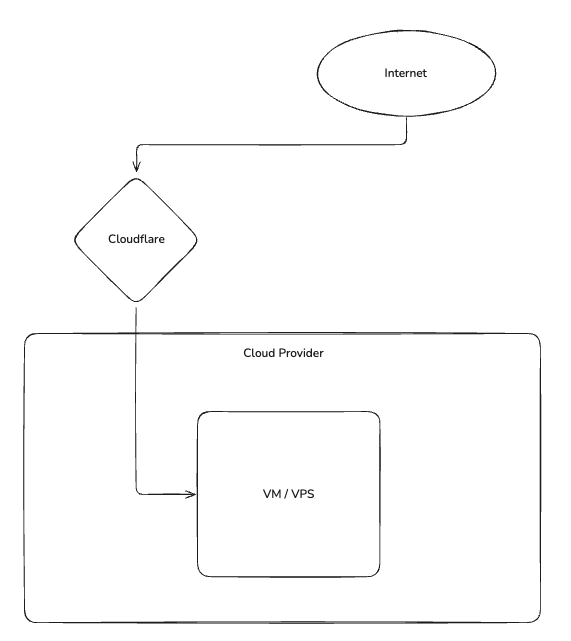
Notes
You must have principles to take advantage of services that are free and widely used by people.
From the simple design example above, we can explore more deeply the features offered by cloud providers and Cloudflare. If you have internet, a computer or mini-PC at home. You can build a system infrastructure and it can be accessed from the public even if you don't have a public IP. You can read the article about how Cloudflare facilitates these needs Cloudflare Zero Trust as a server solution does not have a public IP.
Switch to Virtual Machine (VM) / Virtual Private Server (VPS).
- Use open-source tools to support your application needs.
- For example, you need a Web Server. You can use Apache2, Nginx.
- If the application already supports container base, you can install Podman, Docker, or Kubernetes.
- If you need object storage, you can use Min-IO.
- If you need a database server, you can use MySQL, PostgreSQL, etc.
If we can optimize open-source tools, the costs required to make applications accessible to the public should not be too much. With this design, the costs that need to be spent to build system infrastructure for a startup, for example, in my experience are less than $50, including the domain (depending on what domain).